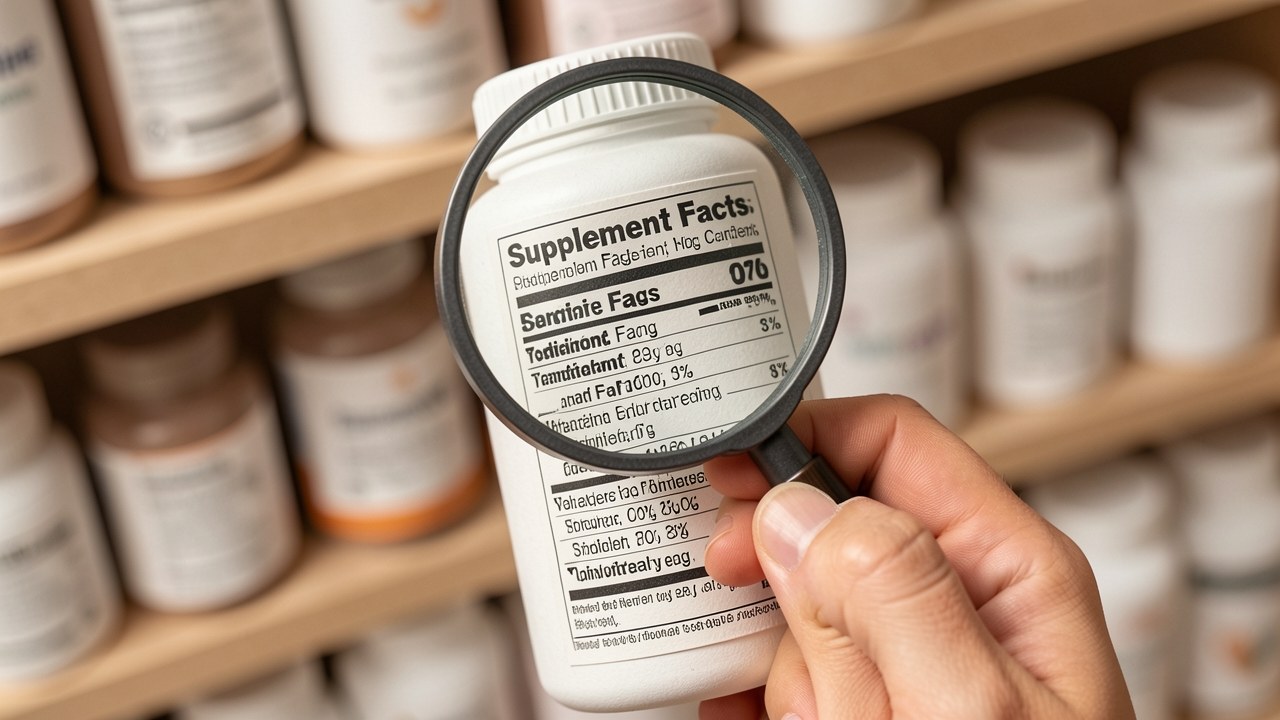
The Importance of the Supplement Facts Label
The Supplement Facts label is the FDA-regulated information panel on dietary supplements in the United States. It provides essential details about the product's serving size, servings per container, dietary ingredients, and the amount of each ingredient per serving. This label is your primary source of information for evaluating what is inside a supplement bottle.
Because the FDA does not pre-approve dietary supplements or verify their accuracy before they are marketed, manufacturers are responsible for ensuring their labels comply with federal regulations. For you as a consumer, this means reading the label carefully is a critical step in assessing whether a product contains what it claims and whether it fits your needs.
Anatomy of the Supplement Facts Panel: Serving Size and Servings Per Container
The Supplement Facts panel must start with the heading 'Supplement Facts' and place the 'Serving Size' subheading directly below it, aligned on the left. The serving size is determined by the manufacturer and expressed in a household measure appropriate for the product's form, such as 'tablets,' 'capsules,' 'packets,' or 'teaspoonfuls.'
Below the serving size, the panel lists 'Servings Per Container.' However, this line may be omitted when the number of servings equals the total net quantity declared on the front of the package. Understanding the serving size is essential because all amounts on the panel refer to one serving, not the entire container.
Sources: Electronic Code of Federal Regulations (eCFR), Intimate Rose
Understanding Amount per Serving and % Daily Value
For each dietary ingredient, the Supplement Facts panel must list the amount per serving using standard units such as grams (g), milligrams (mg), micrograms (mcg), or International Units (IU). Some ingredients also include a Percent Daily Value (%DV), which tells you how much that nutrient in one serving contributes to a daily diet, based on reference values such as a 2,000-calorie diet for certain macronutrients.
Ingredients that do not have an established Daily Value are shown with an asterisk (*) and a footnote stating 'Daily Value not established.' This is common for many botanical extracts, amino acids, and other compounds that lack official reference intakes.
- Amount per serving is expressed in a specific unit like mg or mcg.
- %DV is shown for nutrients with established reference values.
- Ingredients without a Daily Value appear with an asterisk and a footnote.
Sources: Electronic Code of Federal Regulations (eCFR), Labels Unwrapped, Center for Agriculture and Food Systems, Fullscript
Reading the Ingredient List: Active vs. Inactive Ingredients
Dietary ingredients in the Supplement Facts panel are listed by their common or usual name, and they may include the source compound in parentheses. For example, 'Vitamin C (ascorbic acid)' tells you the specific form of the nutrient. Ingredients that are not dietary ingredients, such as fillers, binders, and other excipients, are listed separately in a section called 'Other Ingredients' below the Supplement Facts panel.
Active ingredients are those included for their dietary, nutritional, or physiological effect, while inactive ingredients serve roles like preservation, binding, or coating. By reading both lists, you can identify exactly what you are consuming, including potential allergens or substances you may wish to avoid.
- Look for the full name of each ingredient and its source form.
- Check the 'Other Ingredients' section for excipients and fillers.
- If an ingredient is part of a proprietary blend, individual amounts may not be listed.
Sources: Fullscript, Intimate Rose
Identifying Common Label Elements: Expiration Date, Lot Number, and Manufacturer Info
Expiration dates are not currently required by the FDA on dietary supplement labels. Manufacturers may voluntarily list them if they are accurate and supported by evidence. Potency may decrease over time, and including an expiration date can help you know when to replace the product.
A lot number is a code that identifies a specific batch of production. It can be used for quality control and traceability. Manufacturer information helps you contact the company with questions or concerns about the product.
- Expiration dates are voluntary but helpful for ensuring potency.
- Lot numbers allow for batch traceability in case of issues.
- Manufacturer contact details provide a way to ask questions or report problems.
Sources: Fullscript, Intimate Rose
How to Spot Incomplete or Misleading Label Information
Because the FDA does not pre-approve supplements, it is possible to encounter labels with missing or misleading information. Here are steps to help you identify potential red flags:
Start by checking that the Supplement Facts panel includes all required elements: serving size, all dietary ingredients with amounts, and appropriate units. If an ingredient lacks an amount, it should have an asterisk with a footnote. Also verify that an 'Other Ingredients' section is present if there are non-dietary ingredients.
Be wary of vague claims such as 'boosts immunity' or 'supports weight loss.' While structure/function claims are permissible, they must be accompanied by a disclaimer. If a product promises to diagnose, treat, cure, or prevent a disease, it is violating federal law.
Use external checks: consult the FDA or FTC websites for enforcement actions, and consider third-party verification when available.
- Ensure every dietary ingredient has an amount, even if it's an asterisk for 'Daily Value not established.'
- Check for the presence of an 'Other Ingredients' section when needed.
- Be cautious of labels that claim to treat or cure any disease.
- Look for third-party certifications as an extra layer of verification.
Sources: Performance Lab, Healthline, Fullscript
claims?
Supplement labels often carry claims that describe the product's intended effect. U.S. law distinguishes among structure/function claims, health claims, and nutrient content claims.
Structure/function claims describe how a nutrient affects the normal structure or function of the body. For example, 'calcium builds strong bones' is a structure/function claim. These claims must be accompanied by a disclaimer that the FDA has not evaluated the claim.
Health claims link a substance to reduced risk of a disease and must be approved by the FDA. Qualified health claims are allowed when evidence is less conclusive but include a disclaimer. Nutrient content claims describe the level of a nutrient, such as 'high in vitamin C.'
Sources: Labels Unwrapped, Center for Agriculture and Food Systems, Natural Health Research, Healthline
Structure/Function Claims: What They Promise and Their Limitations
Structure/function claims describe the role of a nutrient in maintaining normal body structure or function. They are allowed without prior FDA approval because they do not relate to disease treatment. However, these claims must be accompanied by a disclaimer: 'This statement has not been evaluated by the Food and Drug Administration. This product is not intended to diagnose, treat, cure, or prevent any disease.'
The disclaimer is a key limitation. It tells you that the FDA has not verified the claim and that the product is not a medicine. If a supplement label makes a structure/function claim without this disclaimer, that is a red flag.
- Structure/function claims must include a specific FDA disclaimer.
- The disclaimer indicates the claim has not been evaluated by the FDA.
Sources: Labels Unwrapped, Center for Agriculture and Food Systems, Fullscript
Health Claims vs. Qualified Health Claims
Health claims on dietary supplements must be authorized by the FDA and are based on scientific evidence that links a substance to a reduced risk of a disease. For a conventional health claim, the FDA has determined that the evidence meets a standard of 'significant scientific agreement.'
Qualified health claims, in contrast, are supported by some evidence but not enough to meet the significant scientific agreement standard. When a qualified health claim is allowed, the label must include a disclaimer stating that the evidence is not conclusive.
- Health claims require FDA approval and significant scientific agreement.
- Qualified health claims have limited evidence and include a disclaimer.
Sources: Natural Health Research, Healthline
The Role of Disclaimers
Disclaimers like 'This product is not intended to diagnose, treat, cure, or prevent any disease' serve a critical purpose: they remind you that dietary supplements are not drugs. They also indicate that the FDA has not evaluated the product's claims. While disclaimers are required for structure/function claims, you should view them as a prompt to be skeptical of the claim itself.
When you see a disclaimer, ask additional questions: Is the claim supported by credible research? Does the product label cite any third-party testing? A disclaimer is not inherently bad—many legitimate supplements include it—but it should make you pay closer attention to the evidence.
Sources: Labels Unwrapped, Center for Agriculture and Food Systems, Fullscript
How to Evaluate the Evidence Behind a Claim
To evaluate whether a supplement claim is credible, consider the following steps:
First, identify what type of claim is being made—structure/function, health, or qualified health. This tells you the level of FDA oversight.
Second, look for specific ingredient names and amounts in the Supplement Facts panel. A claim without a clear dose is harder to evaluate.
Third, seek independent research: search for studies published in peer-reviewed journals, and consult government agencies like the NIH Office of Dietary Supplements or the National Library of Medicine. The FDA and FTC also provide consumer guidance and enforcement information.
- Determine the type of claim to gauge its regulatory review.
- Check that the label provides specific ingredient amounts.
- Look for scientific studies from credible institutions.
- Consider third-party testing seals as an extra layer of verification.
Sources: Natural Health Research, Performance Lab
Frequently asked questions
What is the difference between the Supplement Facts label and the Nutrition Facts label?
The Supplement Facts label is specific to dietary supplements, while the Nutrition Facts label is used on conventional foods. Both are regulated by the FDA, but they have different formats and purposes. The Supplement Facts panel lists dietary ingredients and their amounts, often including botanicals and other compounds not found on food labels. The Nutrition Facts label focuses on nutrients like calories, fat, and sodium, and is required on most packaged foods.
Sources: Electronic Code of Federal Regulations (eCFR), Labels Unwrapped, Center for Agriculture and Food SystemsWhat does % Daily Value mean on a supplement label?
The % Daily Value (%DV) indicates how much a specific nutrient in one serving contributes to a daily diet, based on reference values such as a 2,000-calorie diet for certain macronutrients. It helps you understand whether the product provides a small or large amount of that nutrient relative to general daily needs. For ingredients without an established Daily Value, an asterisk appears with the footnote 'Daily Value not established.'
Sources: Intimate Rose, Natural Health Research, FullscriptHow do I know if a supplement label is accurate?
Since the FDA does not pre-approve supplements or verify labels before they are marketed, you cannot be sure a label is accurate simply by reading it. However, you can look for third-party testing certifications from organizations like NSF International, USP, ConsumerLab, or BSCG. These independent programs verify that the product contains what the label says and that it is free from harmful contaminants. You can also check the FDA's website for enforcement actions or recalls.
Sources: Performance Lab, Healthline, Intimate RoseWhy is the serving size not always what I think?
Serving size is determined by the manufacturer, not by the FDA. It is meant to reflect the amount of product typically consumed at one time, but it may differ from what you personally take. All nutrient amounts on the Supplement Facts panel refer to that specific serving size. If you take more or less than the stated serving, you'll adjust the amounts accordingly, but the %DV is also based on that serving.
Sources: Electronic Code of Federal Regulations (eCFR), Intimate RoseWhat should I do if the label is missing important information?
If a Supplement Facts panel lacks required elements—such as serving size, an amount for a dietary ingredient, or the 'Other Ingredients' section—the product may be out of compliance with FDA regulations. You can report the product to the FDA through its MedWatch program or contact the manufacturer. For guidance, you can also consult the FDA's dietary supplement web pages.
Sources: Electronic Code of Federal Regulations (eCFR), Performance LabCan a supplement claim to cure a disease?
No. Under U.S. law, dietary supplements cannot claim to treat, cure, or prevent any disease. Only FDA-approved health claims may describe a link between a substance and reduced risk of a disease, and those must be supported by scientific evidence. If you see a product claiming to cure a disease, it is violating federal regulations and you should be highly cautious.
Sources: Healthline, Labels Unwrapped, Center for Agriculture and Food SystemsWhat does the disclaimer 'not evaluated by the FDA' mean?
The disclaimer 'This statement has not been evaluated by the Food and Drug Administration' is required for structure/function claims. It means the FDA has not reviewed the claim to determine its validity. It also indicates that the product is not intended to diagnose, treat, cure, or prevent any disease. You should treat unverified claims with healthy skepticism and look for third-party evidence.
Sources: Labels Unwrapped, Center for Agriculture and Food Systems, FullscriptSources
- eCFR :: 21 CFR 101.36 -- Nutrition labeling of dietary supplements. — Electronic Code of Federal Regulations (eCFR)
- How to Read Supplement Labels Like a Pro — Healthline
- How to Read Supplement Labels: Tips & Guide | Fullscript — Fullscript
- How to Read Supplement Labels Like a Pro — Intimate Rose
- How To Read Supplement Labels - Natural Health Research — Natural Health Research
- How to Read Dietary Supplement Labels — Labels Unwrapped, Center for Agriculture and Food Systems
- How to Read Your Supplement Facts Label | Performance Lab® — Performance Lab